



A note on language: Throughout this article, you’ll see us use both “autistic children” and “children with autism.” We do this intentionally, out of respect for the range of preferences within the autism community. Many autistic individuals and self-advocates prefer identity-first language (“autistic child”), while some families prefer person-first language (“child with autism”). Both are used here with equal care and respect.
If you’ve ever stood in a toy aisle — or fallen down an online shopping rabbit hole at 11pm — trying to find the right toy for your child, you know how quickly overwhelming it can get. For parents of autistic children, that feeling can be even more pronounced. You’re not just looking for something fun. You’re looking for something that will actually engage your child and support their needs. The right toy can do a lot. Beyond keeping kids entertained, thoughtfully chosen toys can support sensory regulation, strengthen communication, build fine motor skills, and create space for real joy and connection. That’s worth a little extra research.

This guide is designed to make that research easier. We’ve rounded up toy picks by category so you can skip straight to what’s most relevant for your child — whether they’re a sensory seeker, a budding builder, or someone who finds calm in creative play.
Per our affiliate disclosure, we may earn revenue from the products available on this page. The products in this article were chosen by our editors without bias or paid advertisement. If you would like to support us, so we can create more of this content for you, you can purchase the products from the affiliate links. Thank you!
Shop Our Top Picks By Category
- Best Sensory & Fidget Toys
- Best Building & Construction Toys
- Best Cause & Effect/STEM Toys
- Best Toys for Arts, Crafts, and Creative Play
- Best Social & Communication-Building Toys
- Best Toys for Comfort & Calming
What to Look for in Toys for Autistic Children
Before diving into specific picks, it helps to think through a few key considerations. Autism looks different for every child, and the toys that work beautifully for one child may not land the same way for another. Here’s what to keep in mind as you shop:
Sensory considerations.
Think about your child’s sensory profile. Are they a sensory seeker who craves texture, movement, and stimulation? Or are they sensory-sensitive and easily overwhelmed by loud sounds, bright lights, or unexpected touch? The best toy will work with how your child experiences the world, not against it. When in doubt, look for toys with adjustable settings — volume controls, dimmable lights, or removable parts.
Open-ended vs. structured play.
Some autistic children thrive with open-ended toys that they can use however feels right to them — no rules, no “wrong” way to play. Others do better with structured toys that have clear steps, a defined outcome, or a predictable sequence. Neither is better; it just depends on your child. Many families find that having a mix of both works well.
Developmental stage vs. chronological age.
It’s completely okay — and often more helpful — to shop by your child’s developmental stage rather than their age. A toy labeled for younger children may be exactly the right fit, and there’s no shame in that. What matters is that it engages and supports your child where they are right now.
Durability and safety.
Some kids play with a lot of intensity — squeezing, throwing, chewing, or taking things apart. Look for toys made from non-toxic materials that can hold up to enthusiastic use. If your child mouths objects, always check age-appropriateness and look for chew-safe options specifically designed with that in mind.
Avoiding overstimulation.
More features don’t always mean more fun. Toys that flash, beep, sing, and spin simultaneously can be overwhelming for children who are sensitive to sensory input. When shopping for a child on the more sensitive end of the spectrum, simpler is often better.
Our Picks: The Best Toys for Autistic Children
1. Sensory & Fidget Toys
Good for: sensory seekers, self-regulation, focus
Sensory and fidget toys are often the unsung heroes of an autistic child’s toy collection. For children who seek out sensory input — whether that’s through touch, movement, or pressure — these tools give them a healthy, satisfying outlet. They can also serve as powerful self-regulation aids, helping kids manage big feelings, stay focused, or simply decompress after a stimulating day. The best part? They’re endlessly portable, making them useful at home and on the go.
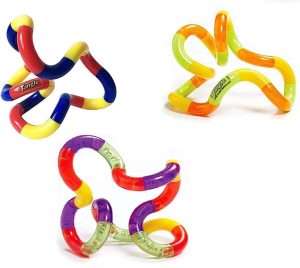
A compact, interconnected fidget toy that twists and bends endlessly. Silent, portable, and a longtime favorite recommended by occupational therapists. Great for school, car rides, and anywhere kids need to keep their hands busy without distraction.
The satisfying bubble-press sensation makes this a hit with kids who crave repetitive tactile input. Available in endless shapes, colors, and sizes, and inexpensive enough to keep multiples around.
Silicone chew jewelry designed for kids who seek oral sensory input. Safe, non-toxic, and discreet enough to wear all day. A practical alternative to chewing on pencils, clothing, or other unsafe items.
2. Building & Construction Toys
Good for: fine motor skills, focus, cause-and-effect learning
There’s something deeply satisfying about building something from nothing — and for many autistic kids, construction play is a natural sweet spot. Whether your child loves the click of magnetic tiles snapping together or the methodical process of stacking blocks just so, building toys offer a structured, predictable experience that can feel both calming and rewarding. They also support fine motor development and spatial reasoning in ways that don’t feel like “work” at all.

The gold standard in magnetic tile play. Pieces snap together with a satisfying click, creating an instantly rewarding building experience. Open-ended, durable, and grow with kids from toddlerhood into elementary years.
A versatile, open-ended LEGO set with no specific instructions — just bricks and imagination. The repetitive, precise clicking of LEGO pieces is particularly satisfying for many autistic children, and the possibilities are genuinely endless.
LEGO’s DUPLO sets feature larger bricks designed for younger or less dexterous builders. Same satisfying snap as classic LEGO but easier for small or developing hands. Available in themes like trains, animals, and community helpers, or in this case — space shuttles!
3. Cause & Effect / STEM Toys
Good for: logical thinking, engagement, and the calming power of predictability
For children who find comfort in knowing what comes next, cause-and-effect toys can be especially engaging. Press this button, the light turns on. Roll the ball down the ramp, it lands in the cup. That predictability isn’t boring — for many autistic children, it’s deeply satisfying. STEM-oriented toys build on this naturally, encouraging curiosity and problem-solving in a way that rewards repetition and experimentation. These are great picks for kids who love to figure out how things work.

A gravity-powered marble run that kids assemble themselves, then watch in action. Combines building with cause-and-effect in a deeply engaging way. Great for older kids who love figuring out how things work.
Kids build real working circuits using color-coded, snap-together pieces. Every completed circuit has a clear, satisfying result — lights, sounds, movement. Highly predictable and deeply engaging for logical thinkers.
These colorful silicone suction cups stick to each other and to surfaces. Kids can connect them, pull them apart (with a satisfying pop), and build whatever they imagine. Simple, tactile, and durable enough to be played with again and again.
4. Arts, Crafts & Creative Play
Good for: sensory exploration, self-expression, open-ended creativity
Creative play is a wonderful outlet for autistic children — and it doesn’t have to look like a Pinterest-worthy craft project to be meaningful. Squishing kinetic sand, rolling playdough, swirling paint across paper — these tactile experiences offer rich sensory input while giving kids a chance to express themselves without words. Arts and craft toys tend to be beautifully open-ended, which means there’s no right or wrong, no pressure, and no finish line. Just the process, which is often where the real magic happens.

Kinetic sand molds like wet sand, flows like a liquid, and never dries out. The tactile experience is consistently described as deeply calming, and it contains itself beautifully without sticking to hands. This set includes crayon-shaped rollers with designs that can be stamped in the sand for added fun.
This ink only shows up on special paper — not on hands, clothes, or surfaces. A great option for kids who love the sensory experience of coloring and painting but are sensitive to mess or who find cleanup stressful. This kit is also great for traveling!
Peel-and-stick mosaic kits like this dinosaur-themed kit produce a fun finished product with no scissors or mess required. The methodical, repetitive nature of placing small pieces is deeply satisfying for kids who love detail-oriented tasks.
5. Social & Communication-Building Toys
Good for: developing communication skills in a low-pressure, playful way

Play is one of the most natural settings for building social and communication skills — and the right toys can make that process feel fun rather than like practice. Emotion cards, social skills games, and puppets give children a tangible, low-stakes way to explore feelings, practice conversations, and engage with others on their own terms. These toys can work well for independent play, one-on-one time with a caregiver, or guided use with a therapist or teacher.
Includes 24 sturdy, double sided puzzles to help your child strengthen emotional awareness skills. This parent’s review says it all: “For any parent seeking effective social-emotional learning toys that cater to young children on the autism spectrum, I can’t recommend the Learning Resources Feelings & Emotions Puzzle Cards enough. It’s really helping her identify facial cues, and the corresponding emotion, which is instrumental to her development and social emotional learning.”
These conversation cards help kids recognize, name, and talk about emotions. Simple enough for young children, and flexible enough to use in one-on-one play with a caregiver or in a small group.
Hand puppets give kids a buffer — they can say things through the puppet that feel too big to say as themselves. Research from the Yale Child Study Center found that autistic children pay closer attention to puppets than to people, making these a powerful communication tool.
6. Comfort & Calm-Down Toys for Kids with Autism
Good for: anxiety, transitions, and moments of sensory overload
Every child has hard moments — and for autistic children, those moments can be especially intense. Having a go-to comfort or calm-down tool can make a real difference, not just in the moment, but in helping kids build their own self-regulation skills over time. Weighted stuffed animals, visual timers, and calm-down kits aren’t just gifts — they’re genuinely useful tools that can support your child’s emotional wellbeing every single day.

Weighted plush toys provide deep pressure input in a huggable, lovable form. This sloth is especially popular! But there are several varieties available so you can choose your child’s favorite animal. Great for transitions, bedtime, and moments of overwhelm.
This 4-pack of sensory tubes each contain a different design, including glitter and beads suspended in liquid that slowly settle when shaken. Watching each one is genuinely soothing and gives kids something to focus on during big feelings.
A complete kit ideal for both homes and classrooms that provides everything you need to create a calming space for a child. This parent says, “Love love loved this for my boys. My son has autism and he needed a place to go to when he was feeling overwhelmed or overstimulated. The posters are easy to understand even if you can’t read.”
Editor’s Tips for Shopping
You know your child better than any product description ever could. Here are a few reminders to keep in mind as you browse:
Follow your child’s lead.
A toy that aligns with your child’s existing interests will almost always win out over one that’s been labeled “great for autism.” If your child is obsessed with trains, space, or a particular color — lean into that. Interest is the best engagement tool there is.
Think about when, not just what.
A calm-down toy for winding down after school is a very different need than an engaging activity toy for a rainy afternoon. Consider the moments in your child’s day that feel hardest, and let that guide what you’re shopping for.
When in doubt, go simpler.
If your child is sensitive to noise or lights, toys with lots of bells and whistles — sometimes literally — may cause more stress than joy. Look for toys with off switches, volume controls, or no electronic components at all.
Factor in durability.
Some kids are enthusiastic players — and that’s a wonderful thing. Look for toys that can keep up. Read reviews with an eye toward how the toy holds up to repeated, intense use.
Frequently Asked Questions
What kinds of toys are best for autistic children?
There isn’t a “one size fits all” solution to this. The truth is that the best toys for autistic children are the ones that match your individual child’s sensory needs, interests, and developmental stage — and you know your child best. That said, toys that offer predictable outcomes, sensory input, or open-ended exploration tend to be consistently popular. The categories in this guide — sensory toys, building toys, creative play, and more — are a great starting point.
Are there toys that help with sensory processing?
Yes! Sensory toys are specifically designed to provide the kind of input that helps children regulate their nervous systems. Weighted items, textured objects, fidget toys, and kinetic materials like sand or putty can all support sensory processing. The key is matching the toy to your child’s specific sensory needs — whether they seek more input or need help calming an overloaded system.
What’s the difference between sensory-seeking and sensory-avoiding, and how does that affect toy choice?
Sensory-seeking children crave stimulation — they may love rough textures, spinning, jumping, or squeezing. Sensory-avoiding children, on the other hand, can be easily overwhelmed by certain sensations, sounds, or lights. For sensory seekers, toys with rich tactile or movement input are usually a hit. For sensory-avoiders, simpler, quieter, and more predictable toys tend to work better. Many autistic children fall somewhere in between, or may seek input in some areas while avoiding it in others.
Are there toys that can help with communication and social skills?
Absolutely. Toys like emotion cards, social skills games, and puppets create natural, low-pressure opportunities to practice communication and explore emotions. These work especially well when used alongside a caregiver, therapist, or sibling — but many kids enjoy them independently, too. The goal isn’t to “drill” social skills, but to create playful, enjoyable moments where connection can happen organically.
What age should I shop by — my child’s actual age or developmental stage?
Developmental stage, always. Age ranges on toy packaging are general guidelines, and they don’t account for the wide variation in how children develop. There is absolutely no shame in choosing a toy designed for younger children if it’s the right fit for your child right now. What matters most is that the toy is engaging, safe, and meets your child where they’re at developmentally.
Are there toys I should avoid for autistic children?
It really depends on the child, but a few general things to watch for: toys with sudden loud noises or unpredictable sounds can be distressing for sensory-sensitive children. Toys with very small parts may not be safe for children who mouth objects. And highly complex toys with lots of steps or rules may be frustrating for children who are still developing those skills. When in doubt, read reviews from other parents of autistic children — they’re often the most useful resource.
Can neurotypical siblings play with these toys too?
Without a doubt. Sensory toys, building sets, creative play materials, and calm-down tools are fun and beneficial for all kids. In fact, many families find that these toys become household favorites for everyone. Shared play is a wonderful thing, and toys that support connection between siblings are always a win.
Every Child Is Different — And That’s the Point
Shopping for an autistic child can feel like a lot of pressure. But here’s the thing: you are already the expert on your child. You know their quirks, their passions, the things that light them up and the things that wind them down. This guide is just here to give you a few new ideas to work with. There’s no perfect toy, and there’s no playbook that works for every child. What matters is that you’re paying attention, showing up, and looking for things that support your kid in being exactly who they are. That effort and care is what makes all the difference. We hope something in this list sparks a little excitement, for your child and maybe for you too.
Looking for more family fun? Be sure to check out our guides on the best puzzles for kids of all ages and inclusive playgrounds in Central New York.
For local sensory-friendly times and helpful resources, we recommend our guide to autism-friendly and sensory-friendly activities in CNY.

