



The best toys for kids with ADHD give them a clear way to move, focus, fidget, or calm down through play. Because children with ADHD often deal with sensory-seeking behavior, toys that bring movement, tactile input, or calming repetition usually work better than toys that blast music or pile on too many features.
You know your child better than anyone. Your kid may need to crash, spin, wobble, or push until they feel calm. Maybe they do better with quieter hands-on play that keeps their brain engaged without turning the room into chaos.

If you’re ready to compare options, explore the product links throughout this guide.
Per our affiliate disclosure, we may earn revenue from the products available on this page. The products in this article were chosen by our editors without bias or paid advertisement. If you would like to support us, so we can create more of this content for you, you can purchase the products from the affiliate links. Thank you!
Shop Our Top Picks by Category
- Best toys for preschoolers with ADHD
- Best toys for early elementary kids with ADHD
- Best toys for older kids with ADHD
- Best calming sensory toys
- Best active movement toys
How to Choose the Best Toys for Kids With ADHD
The best toys for kids with ADHD tend to support focus, offer useful sensory input, encourage movement, or help a child calm down after getting overstimulated. That doesn’t mean every child needs the same type of toy. One child may settle beautifully with kinetic sand, while another may need a wiggle toy, spinning chair, or building set to feel more regulated.
Consider Your Child’s Unique Needs
Sensory input is a big piece of the puzzle. Tactile toys can help a child stay engaged without asking them to sit perfectly still. Movement toys can give the body a job, which makes it easier for the brain to pay attention. Calming toys can help children shift gears after school, before homework, or during moments when emotions start running hot.
Look at Your Child’s Preferences
Overstimulating toys can cause more problems than they solve. A toy with bright flashing lights, repetitive electronic sounds, and too many buttons may grab their attention for a minute, then leave them even more dysregulated than before.
Remember Your Child’s Age and Attention Level
Age is a factor, but sensory preference matters just as much. A 9-year-old who chews pencil erasers and rocks in their chair may benefit more from a tactile calming toy than from a complicated STEM set, while another child the same age may love a puzzle that channels energy into problem-solving and helps keep their focus for longer.
Look for toys that:
- Encourage movement or tactile engagement so your child can stay involved instead of fighting their body’s need for input
- Support focus without overstimulation by giving the brain one clear job at a time
- Are durable and safe enough for repeated use, because ADHD-friendly toys often get used hard and are revisited often
Avoid toys that:
- Flash excessively, especially if your child already gets overwhelmed by busy visuals
- Make a loud, repetitive noise that keeps escalating the energy in the room
- Overload your child with too many features or rules
Best Toys for Preschoolers With ADHD (Ages 3-5)
Preschoolers usually do best with simple cause and effect, physical play, and sensory feedback they can understand right away.
Fat Brain Toys Teeter Popper

This is a wobble toy that turns movement into focused play. It’s best for big body movement and a child who needs more sensory input.
You’ll find that the Fat Brain Toys Teeter Popper is a strong fit for preschoolers who are constantly rocking in chairs, crashing into couch cushions, or looking for sensory feedback all day long. Its curved shape lets kids sit, stand, tilt, and rock, while the silicone suction cups underneath add a satisfying popping sensation. That mix can help channel hyperactivity into safer, more organized movement.
Pros:
- Gives sensory-seeking preschoolers a physical outlet that feels fun instead of corrective
- Works in more than one position, so kids can sit in it, stand on it, or rock with it
- Holds up well for kids who play roughly or come back to the same movement toy every day
Cons:
- Takes up more floor space than a typical fidget toy
- The popping sound may get old on hard floors
Pushpeel XL Sensory Activity Board for ADHD

A hands-on sensory board for kids who need busy fingers and quiet tactile playtime.
The Pushpeel XL Sensory Activity Board for ADHD is a quieter option for preschoolers who focus better when their hands are occupied. The push-pull activity creates repetitive tactile input without lights, screens, or electronic noise. That makes it useful for calmer play windows, car rides, waiting rooms, or any moment when your child is wound up but not looking for full-body movement.
Pros:
- Can redirect grabbing, picking, or constant fidgeting into something more constructive
- Stays much quieter than many ADHD sensory toys
- Easy to wipe down after use at the table, in the car, or outside
Cons:
- Kids who need big movement may lose interest quickly
- Open-ended sensory play may feel too loose for children who want a clearer goal
Best Toys for Early Elementary Kids With ADHD (Ages 6-8)
Kids in this age range often need toys that help with transitions, focus breaks, and hands-on engagement.
Sensory Fidget Handheld Game
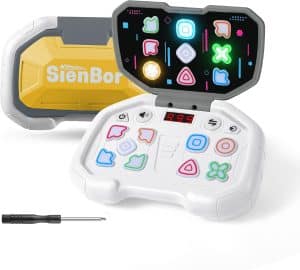
This is a compact fidget game for restless hands and on-the-go focus breaks.
A handheld sensory toy can be surprisingly useful for kids who need a small, portable way to stay regulated. The Sensory Fidget Handheld Game works well for short focus breaks between tasks, car rides, homework transitions, or quiet moments when your child wants input without running laps through the house. Because it gives the hands a clear job, it can help some kids settle enough to listen, wait, or regroup.
Pros:
- Easy to carry, which makes it more realistic for everyday use than a larger sensory setup
- Can support focus during downtime, especially for kids who tap, pick, or interrupt while waiting
- Gives immediate sensory feedback that many children find satisfying
Cons:
- Some kids move through small fidget toys quickly and need regular rotation
- Handheld toys may need closer supervision if your child throws things when frustrated
Magna-Tiles 74-Piece Set

Magna-Tiles are some of the best toys for kids with ADHD who do better when focus grows out of creativity. Instead of asking a child to sit still and pay attention, they invite them to build, test, rebuild, and stick with one idea longer because the activity is genuinely absorbing. That can make these magnetic tiles excellent focus toys for ADHD, especially for children who enjoy visual-spatial play and hands-on problem-solving.
A magnetic building set rewards concentration. It’s ideal for creative focus and open-ended building fun.
Pros:
- Open-ended play often keeps ADHD brains engaged longer than toys with one fixed outcome
- Building can support planning, patience, and frustration tolerance without feeling like schoolwork
- Bright and appealing without being noisy or overloaded with extra features
Cons:
- Cleanup can be a sticking point if your child leaves every build spread across the floor
- Kids in a very physical, high-energy phase may not reach for these first
Best Toys for Older Kids With ADHD (Ages 9-12)
Older kids often want toys that feel less babyish and more purposeful. Challenge and novelty are super important here.
Perplexus Beast 3D Gravity Maze Game

Perplexus Beast works especially well for older kids who crave a challenge and stick with things longer when there’s a clear objective. It’s a maze ball that turns focus into a mission and encourages challenge-driven concentration.
Guiding the ball through the maze takes visual tracking, motor control, and sustained attention, so it can help channel racing thoughts into one concrete task. For some kids, that kind of puzzle feels more regulating than passive downtime.
Pros:
- Gives older kids a real sense of challenge instead of a toy that feels too simple
- Encourages persistence, which helps children who quit as soon as something feels hard
- Keeps both hands and eyes busy, which can make it a strong choice for active focus
Cons:
- Frustration can build on a low-tolerance day
- Better for solo play than group play
SHASHIBO Shape Shifting Box Magnetic Fidget Cube

The SHASHIBO Shape Shifting Box Magnetic Fidget Cube feels more substantial than a basic popper. It’s a transforming fidget cube that keeps hands busy, and is a great choice for older kids who constantly have the urge to fidget.
Folding, flipping, and reshaping it gives older kids tactile feedback without making them feel like they’re using a toy meant for preschoolers. It also adds novelty, which helps with kids who burn through simple fidgets fast.
Pros:
- Gives older kids more to do than a repetitive squeeze toy
- Easy to keep nearby during homework breaks, reading time, or transitions
- Can help redirect nail-picking, pen-clicking, or constant desk tapping
Cons:
- Easy to lose in shared spaces or backpacks
- Kids who get distracted by novelty may end up playing with it instead of listening
Best Calming Sensory Toys for Emotional Regulation
Children who get overwhelmed often need toys that lower stimulation, not increase it.
Kinetic Sand Sandyland Folding Sandbox

Are you looking for a more contained sensory play option that feels soothing? Kinetic Sand is a favorite for a reason. The slow squish, scoop, and mold action can help children come down from a big-feelings moment without demanding eye contact, conversation, or stillness.
For families looking for calming toys for children with ADHD, the fold-up sandbox setup also helps keep the mess more manageable.
Pros:
- Repetitive tactile play can be calming for kids who regulate best through their hands
- Gives children a low-pressure way to decompress after school, transitions, or social overload
- The folding sandbox makes setup and cleanup more realistic for everyday family life
Cons:
- Children who dislike residue on their hands may avoid it
- Still not something every parent wants opened on the rug before dinner
Sensory Stone Fidget Toy

The Sensory Stone Fidget Toy is better suited to kids who calm down through small, repetitive hand motions than through big movements. It’s a pocket-sized and compact fidget toy that’s useful for a bit of quiet emotional regulation.
It’s also the kind of toy that can live in a backpack, on a bedside table, or in the car for moments when your child needs something grounding right away. For parents shopping for ADHD sensory toys, easy access matters.
Pros:
- Small enough for real-life use, not just playroom use
- Repetitive tactile input can help some kids ride out frustration or waiting time without escalating
- Can work well as part of a calm-down kit
Cons:
- Tiny fidgets are easy to misplace
- Children who need strong movement or deep pressure may find it too subtle
Best Active Movement Toys for Hyperactive Kids
Movement toys should do more than burn energy. The best ones help turn restless motion into something safer and more organized.
Toy Time Kids’ Wiggle Car Ride-On Toy
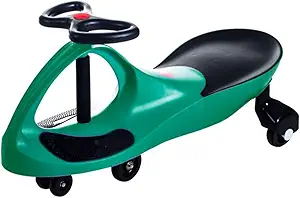
Some kids simply need to move before they can do anything else well. The Toy Time Kids’ Wiggle Car Ride On Toy gives hyperactive kids a way to burn energy through steering, shifting, and core-driven movement. That can be a much better option than hearing “stop bouncing on the couch” all day.
It’s a ride-on toy that turns movement into a calming motion. If you find your child needs more of an energy release, this is a good option.
Pros:
- Gives high-energy kids a way to move with purpose, which can reduce crashing, pacing, and furniture climbing
- The seated ride-on format feels fun instead of therapeutic
- Can work well before homework or quieter activities when your child needs a physical reset first
Cons:
- Needs open floor space
- Works best on smooth surfaces
LLNC Kids Sensory Spinning Chair

Does your child regulate better when movement is involved? The LLNC Kids Sensory Spinning Chair can be a strong choice for children who seek vestibular input and seem calmer after spinning, rocking, or rotating. For the child who’s always twisting upside down on the sofa or spinning until they fall over and laugh, that kind of safer movement outlet can be incredibly useful.
Pros:
- Gives motion-seeking kids a designated place to spin instead of using household furniture
- Vestibular input may help some children feel more organized after active play
- The higher weight capacity makes it more practical for longer-term use
Cons:
- Not a fit for every child, especially those who get dizzy easily or become more revved up
- You’ll need enough room to use it safely
| Toy Type | Best For | Age Range | Key Benefit |
|---|---|---|---|
| Fidget Toys | Focus during tasks | 5+ | Helps reduce restlessness and improve concentration |
| Sensory Toys | Calming and regulation | 3+ | Provides tactile input to soothe and center attention |
| Building Sets | Focus + creativity | 6+ | Encourages problem-solving and sustained engagement |
| Active Play Toys | High-energy kids | 4+ | Burns off excess energy to improve later focus |
| Weighted/Pressure Toys | Calming and anxiety relief | 5+ | Promotes a sense of security and relaxation |
Why These Toys Work
Toys designed for kids with ADHD can do more than entertain—they can support focus, emotional regulation, and overall engagement when chosen and used appropriately. Many children with ADHD benefit from sensory input, which helps the brain stay stimulated in a controlled way. Tactile toys like putty, stress balls, or textured fidgets provide a physical outlet for excess energy, allowing kids to concentrate better on tasks like homework or reading. Movement-based toys, such as balance boards or active play sets, can also improve attention by giving the body a chance to release built-up energy. At the same time, hands-on and problem-solving toys encourage sustained engagement and cognitive development. It’s important to note, however, that results vary—while some children focus better with a fidget in hand, others may find certain toys distracting. The key is matching the toy to the child’s specific sensory needs and environment.
What to Avoid
Not all toys are helpful for children with ADHD, and some can actually work against the goal of improving focus and calm. Overstimulating toys—especially those with excessive lights, loud noises, or rapid movement—can overwhelm the senses and make it harder for kids to regulate their attention. Similarly, toys that lack structure or purpose may quickly turn into distractions rather than tools for engagement. It’s also important to avoid a one-size-fits-all approach; what works well for one child may not work for another, depending on their individual sensory preferences and triggers. Parents should be mindful of how a toy is being used—if it pulls attention away from the task at hand rather than supporting it, it may not be the right fit. Taking a trial-and-error approach, while observing how a child responds, is often the best way to identify toys that truly help rather than hinder.
Do Toys Replace ADHD Treatment?
While the right toys can be incredibly helpful tools, they are not a replacement for professional ADHD treatment. Sensory toys, fidgets, and active play options can support focus, reduce anxiety, and help kids manage energy levels, but they work best as part of a broader approach. Structure, consistent routines, behavioral strategies, and guidance from healthcare professionals all play an important role in helping children with ADHD succeed. Think of these toys as supportive tools—ways to enhance focus and emotional regulation in everyday situations—rather than a standalone solution.
Finding the Best ADHD Toys for Your Child
The best toys for kids with ADHD work with their brain and body instead of against them. Many children need calming toys that help them settle, and, of course, quiet time calls for focus toys that keep their hands active to help their minds stay locked in.
Kids with ADHD need a ton of movement to let off steam, plain and simple. So, this means you may need to try a couple of different options before you land on the right fit, and that’s completely normal.
Start by thinking about the kind of stimulation your child seeks, whether that’s tactile input, motion, challenge, or calm repetition. Then click through the product links above to compare features and choose the toy that feels like the best match for your child’s needs.
If you’re looking for something else for your home and playroom, see our picks for Best Family Board Games and The Best Outdoor Ride-On Toys for Kids.

